
Dump trailers (also called tipper trailers or dumper trailers) are essential for aggregate, mining, and construction material haulage. The choice between rear-tip and side-tip configurations significantly affects discharge efficiency, payload capacity, and operating flexibility. This guide helps you choose the right configuration for your specific application.
What is a Dump Semi Trailer?
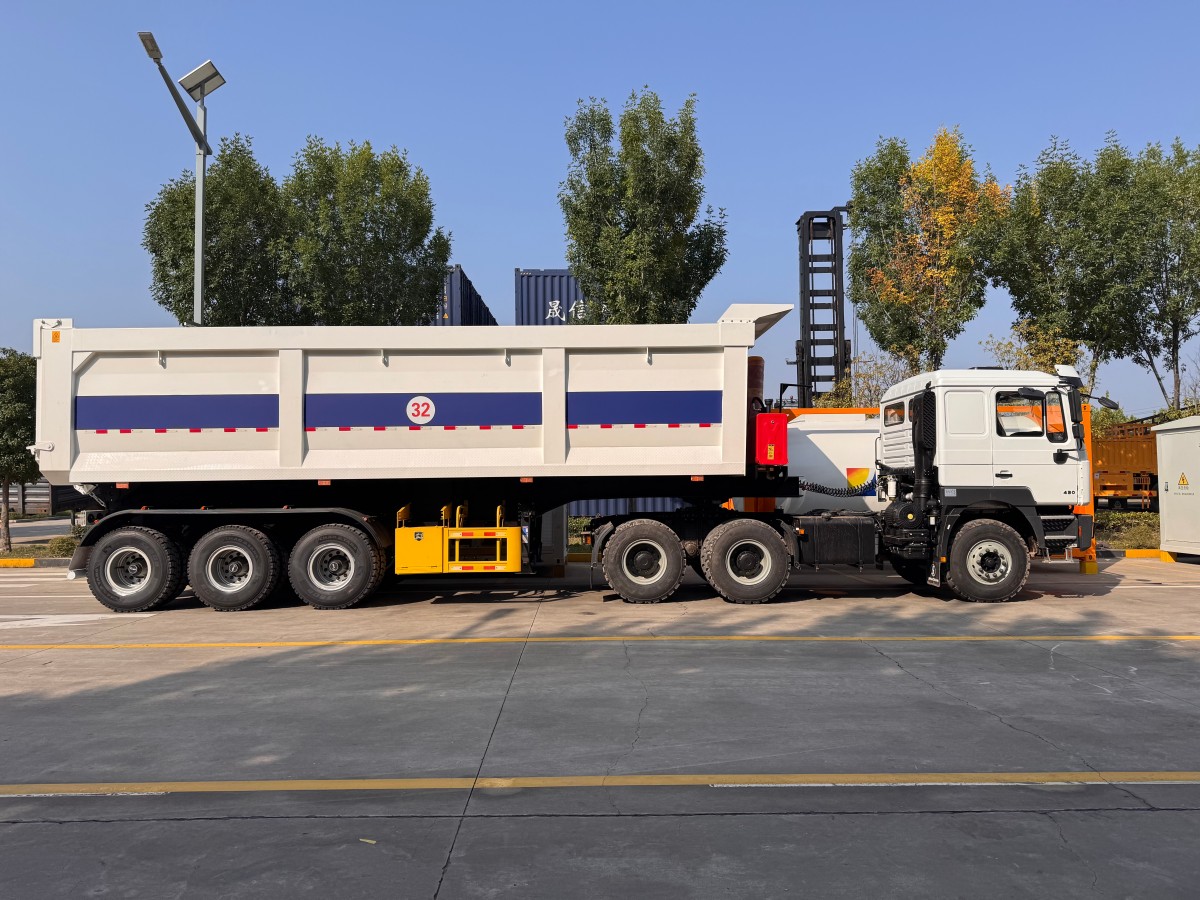
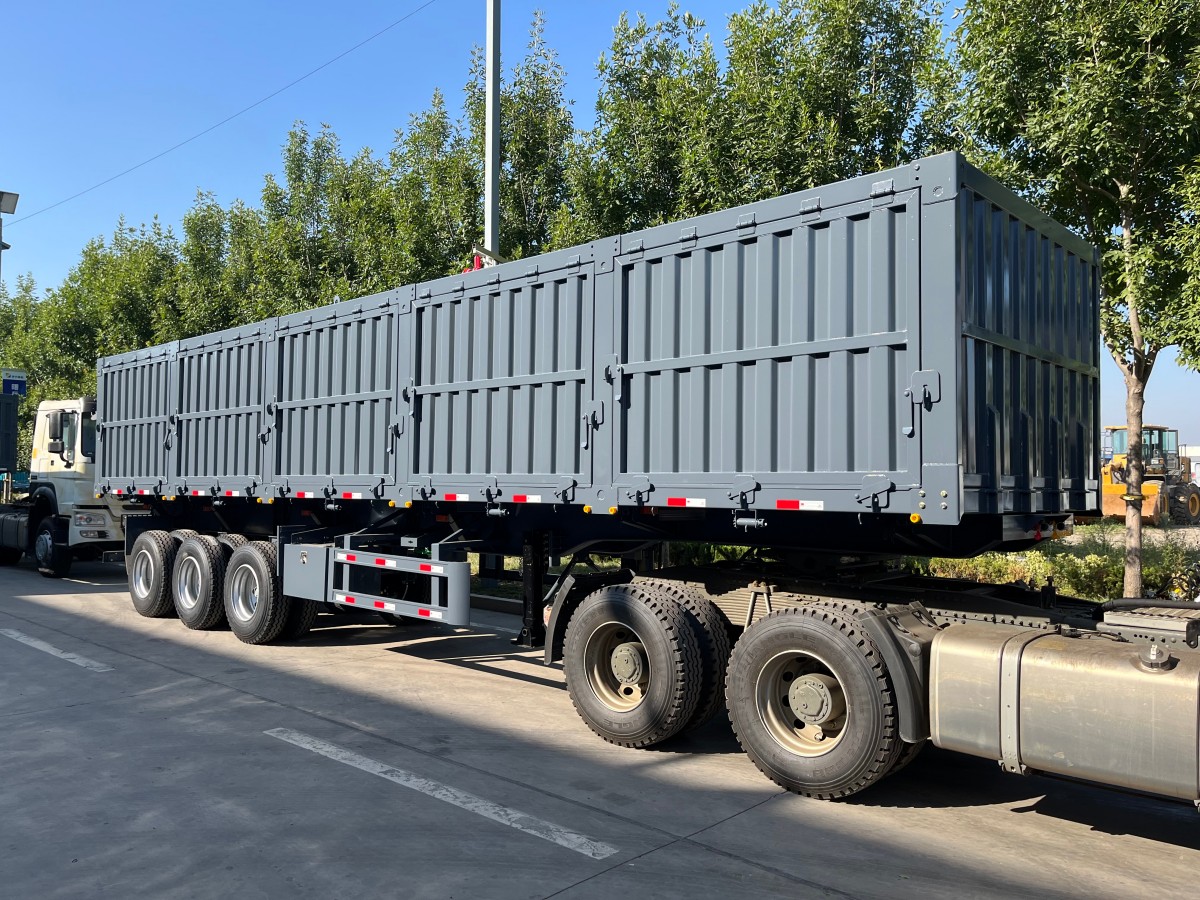
A dump semi trailer is a hydraulic-tipping trailer designed for fast discharge of bulk materials. Unlike flatbeds or tankers, dump trailers have an integrated hydraulic cylinder that lifts the front of the trailer body, allowing gravity-assisted discharge of the load.
Common applications include:
- Sand, gravel, and aggregate transport
- Mining ore and overburden
- Construction debris and demolition waste
- Coal and coke haulage
- Agricultural bulk products (grain, fertilizer)
- Asphalt millings and recycled pavement
Rear Tip vs Side Tip – Key Differences
Rear-Tip Dump Trailer
How it works: Hydraulic cylinder mounted at the front of the trailer lifts the front of the body, with the rear pivot acting as the hinge. Material slides out the rear gate.
Advantages:
- Lower cost (simpler hydraulic system)
- Higher payload (no side reinforcement needed)
- Better for sticky materials (full gravity discharge)
- Easier maintenance
- Standard configuration worldwide
Disadvantages:
- Requires headroom for tipping (typically 8-10 meters of clearance behind)
- Not suitable for confined spaces
- Rear gate must open reliably
Side-Tip Dump Trailer
How it works: Hydraulic cylinder mounted along the side of the trailer body lifts one side, with the bottom pivot acting as the hinge. Material discharges out the side.
Advantages:
- No headroom required (can discharge against walls or in tunnels)
- Faster discharge (typically 30-40 seconds vs 45-60 seconds for rear-tip)
- Better for confined tipping zones (urban construction, underground mining)
- Higher discharge rate (tonnes per hour)
Disadvantages:
- Higher cost (more complex hydraulic system, reinforced sides)
- Slightly lower payload (side reinforcement adds weight)
- Higher center of gravity during tipping (stability concerns)
- Less common – parts and service may be limited
Hydraulic System Specifications
Hydraulic Cylinder
The hydraulic cylinder is the heart of any dump trailer. Specifications to verify:
- Brand: HYVA (Netherlands, global standard) or domestic Chinese equivalent
- Cylinder type: Telescopic (multi-stage) for greater lifting range
- Bore size: Common sizes are 196#, 220#, 245# (larger = more lifting force)
- Stages: 4-5 stages for high-volume trailers
- Working pressure: 16-20 MPa typical
Pump and PTO
The hydraulic pump is powered by the tractor’s Power Take-Off (PTO):
- Pump type: Gear pump or piston pump
- Flow rate: 60-100 L/min typical
- Tractor PTO: Must be matched – most common is 6-bolt flange or direct drive
- Tipping cycle time: 30-60 seconds for full lift and lower
Hydraulic Oil Tank
- Capacity: 100-200L depending on cylinder size
- Material: Steel with internal anti-corrosion coating
- Filters: Suction strainer + return line filter
Body Construction
The dump trailer body takes the most abuse during operation. Construction quality directly affects service life:
Body Materials
- Side walls: Q345B steel, 5-8mm thickness (heavier for mining applications)
- Bottom plate (floor): Q345B steel, 6-10mm thickness (thickest at the front where impact is greatest)
- Front wall: Reinforced to handle the load shock during tipping
Wear Plates
For high-abrasion materials (ore, slag, demolition waste), specify:
- NM400 wear plate on the floor (instead of standard Q345B)
- Hardox 450 for extreme abrasion (premium option)
- Replaceable wear plates at the front of the body
Tailgate
The rear gate must open reliably to release the load:
- Air-operated tailgate (standard) – opens via air cylinder
- Hydraulic tailgate – opens via hydraulic cylinder
- Auto-opening tailgate – opens automatically when body lifts past a certain angle
- Asymmetric tailgate – opens only at the top, useful for controlled partial discharge
Capacity and Payload
Dump trailer capacity is typically specified by volume (cubic meters) and payload (tons):
| Configuration | Volume | Payload | Material Density Assumed |
|---|---|---|---|
| 3-axle 30m³ | 30 m³ | 40-50 tons | Sand/gravel (1.5-1.7 t/m³) |
| 3-axle 40m³ | 40 m³ | 50-60 tons | Aggregate (1.4-1.6 t/m³) |
| 4-axle 50m³ | 50 m³ | 60-80 tons | Aggregate/coal (1.2-1.5 t/m³) |
| 4-axle U-shape 60m³ | 60 m³ | 70-90 tons | Lightweight ore (1.0-1.4 t/m³) |
Country-Specific Recommendations
Different regions prefer different dump trailer configurations based on road infrastructure and operating conditions:
Africa (Nigeria, Kenya, Tanzania, South Africa)
Heavy aggregate haulage is the dominant application. Specify:
- Rear-tip configuration (lower cost, easier to maintain)
- 3 or 4-axle configuration
- Reinforced body (8mm floor minimum) for poor road conditions
- Air tailgate (more reliable in dusty conditions)
- Spare tire carrier
Middle East (Saudi Arabia, UAE, Qatar)
Construction aggregate and sand haulage. Specify:
- Rear-tip for cost-sensitive operations, side-tip for fast-cycle construction
- Air suspension for high-speed highway operation
- Larger volume (40-60 m³) for long-distance routes
- Heat-resistant paint and seals
South America (Brazil, Chile, Peru, Guyana)
Mining haulage is significant. Specify:
- Rear-tip U-shape body (highest volume per trailer)
- 4-axle configuration for heavy ore
- NM400 wear plates on floor
- Heavier body reinforcement for off-road conditions
FOB Price Ranges (2026 Reference)
| Spec Level | 3-Axle Rear-Tip | 4-Axle U-Shape Rear-Tip | 3-Axle Side-Tip |
|---|---|---|---|
| Economy | $14,000-18,000 | $18,000-22,000 | $16,000-20,000 |
| Standard (HYVA cylinder, BPW axles) | $18,000-23,000 | $22,000-28,000 | $20,000-25,000 |
| Premium (air suspension, NM400 floor) | $23,000-28,000 | $28,000-35,000 | $25,000-30,000 |
Maintenance Considerations
Dump trailers require more frequent maintenance than other trailer types due to the hydraulic system and high-stress body operation:
Daily Checks
- Hydraulic oil level and condition
- Tailgate operation
- Tire condition and pressure
Weekly Checks
- Body floor wear (look for thin spots)
- Suspension bushings
- Hydraulic cylinder seals
Annual Maintenance
- Hydraulic oil change
- Cylinder seal replacement (every 2-3 years)
- Body repainting (every 4-5 years)
- Suspension overhaul
Decision Framework
Use this checklist to choose your dump trailer configuration:
- What is your typical payload? Under 40 tons -> 3-axle. Over 40 tons -> 4-axle.
- What is your discharge environment? Open area -> rear-tip. Confined space -> side-tip.
- What is your cycle time priority? Under 45 seconds -> side-tip. Over 45 seconds acceptable -> rear-tip.
- What is your material density? Heavy (over 1.7 t/m³) -> reinforced body. Light -> standard.
- What is your operating region? Africa -> rear-tip standard. Mining regions -> U-shape + NM400.
Conclusion
For most aggregate haulage operations, a 3-axle rear-tip dump trailer with HYVA hydraulic cylinder offers the best combination of payload, reliability, and cost. Choose side-tip only when fast discharge in confined spaces is essential. Choose U-shape body for high-volume mining haulage.
Need help selecting the right dump trailer for your operation? Contact our engineering team with your typical payload, material type, and discharge environment – we’ll recommend the optimal configuration.
See Related Products
Related Articles
Related Products
Need a Quotation? Contact Our Export Team
Browse our full catalog, search for specific models, or send us your requirements. Our sales engineers respond within 12 hours.
Phone: +86 13113678017 | Email: postmaster@trailerintl.com