
When you need to move a 30-ton excavator, a 50-ton bulldozer, or a 100-ton transformer, no standard flatbed will do. You need a lowboy trailer (also called lowbed or low-loader) – the specialized equipment transporter designed specifically for heavy and oversized cargo.
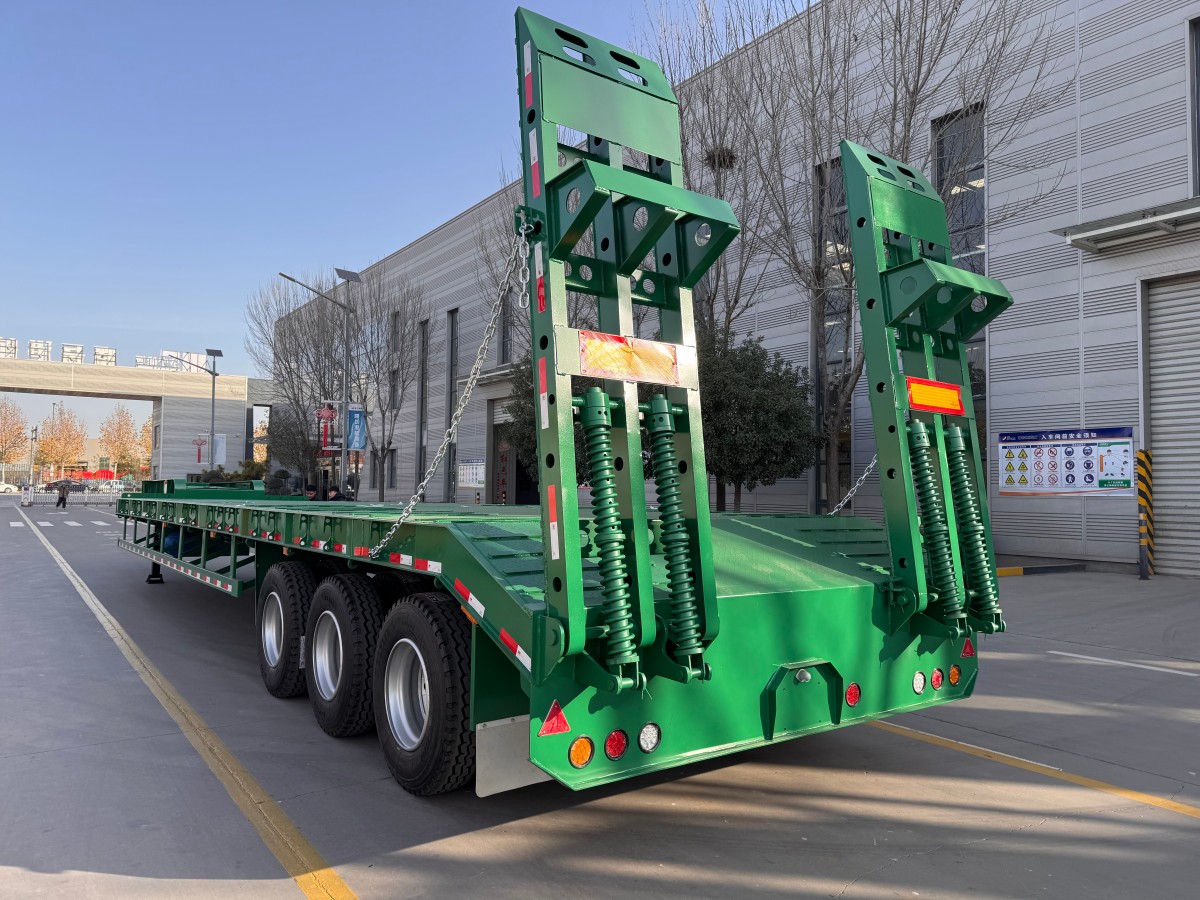
What is a Lowboy Trailer?
A lowboy trailer is characterized by:
- Lower deck height (typically 800-1300mm vs 1500-1600mm for flatbed)
- Gooseneck front section (allowing taller cargo clearance above the tractor)
- Hydraulic or mechanical loading ramps at the rear
- Concentrated axle loadings (often multiple closely-spaced axles)
The lower deck height allows taller cargo to be transported within standard road height limits, while the gooseneck design lets the cargo ride over the tractor’s fifth wheel area.
Common Applications
Lowboy trailers are used for transporting:
- Construction equipment: excavators, bulldozers, wheel loaders, backhoes
- Road construction equipment: pavers, rollers, milling machines, asphalt plants
- Mining equipment: haul trucks, drilling rigs, processing equipment
- Agricultural equipment: large tractors, combine harvesters
- Industrial equipment: generators, compressors, transformers
- Military equipment: tanks, APCs, artillery
- Construction elements: prefabricated building sections, bridge girders
- Cranes: mobile and crawler crane components
Standard Configurations
2-Axle Lowboy
For lighter equipment transport:
- Payload: 20-40 tons
- Deck height: 850-1000mm
- Typical cargo: Small excavators (CAT 320 class), mini loaders, small bulldozers
- FOB price: $10,000-15,000
3-Axle Lowboy (Most Common)
The workhorse configuration:
- Payload: 40-60 tons
- Deck height: 900-1100mm
- Typical cargo: Mid-size excavators (CAT 330 class), bulldozers (CAT D6 class), mid-size wheel loaders
- FOB price: $15,000-22,000
4-Axle Lowboy (Heavy-Duty)
For large construction and mining equipment:
- Payload: 60-80 tons
- Deck height: 1000-1200mm
- Typical cargo: Large excavators (CAT 345/374 class), large bulldozers, mining trucks (rigid frame disassembly)
- FOB price: $22,000-30,000
Multi-Axle Heavy Lowboy
For very heavy equipment:
- Payload: 80-100+ tons
- Deck height: 1100-1300mm
- Typical cargo: Mining trucks, large transformers, oversized construction equipment
- FOB price: $30,000-50,000
Critical Specifications
Main Beam
The main beam takes exceptional stress during loading and transport:
- Steel grade: Q345B or T700
- Height: 500-550mm (heavier than standard trailers)
- Thickness: Top 14-16mm, Bottom 16-20mm, Middle 8-10mm
- Welds: Full penetration, 100% X-ray tested on critical seams
Gooseneck Design
The gooseneck is what allows lowboys to carry tall equipment:
Fixed Gooseneck
Standard for most lowboys. Lower cost but limits cargo length to the main deck area. Suitable for excavators, bulldozers, and most construction equipment.
Detachable Gooseneck (Hydraulic)
The gooseneck can be hydraulically detached from the main deck, allowing:
- Loading of extremely tall or long cargo (cranes, tanks)
- Loading from the front (instead of just the rear)
- Higher payload (no gooseneck weight)
- Premium feature, adds $8,000-15,000 to the price
Mechanical Detachable Gooseneck
Lower-cost version of detachable gooseneck using manual or mechanical jacks. Slower operation but more reliable than hydraulic.
Ramps
Ramps are critical for self-loading equipment:
Mechanical Spring Ramps
- Lower cost
- Spring-assisted lifting
- Suitable for lighter equipment (under 30 tons)
Hydraulic Ramps
- Hydraulic cylinder operation
- Smoother control
- Better for heavy equipment (30+ tons)
- More expensive but faster operation
Fold-Down Ramps
- Single piece, folds flat for transport
- Quick deployment
- Mid-cost option
Axle Configurations and Brands
Lowboy axles are typically:
Axle Brands
- BPW (Germany) – Premium, global parts availability
- FUWA (China) – Mid-tier, reliable
- SAF-Holland (Germany) – Premium for heavy-haulage
Axle Spacing
Tandem axle spacing affects load distribution:
- Standard tandem spacing: 1310-1360mm
- Spread axle spacing: 1810-1860mm (better for off-road and poor roads)
Suspension
- Mechanical (leaf spring): Standard, lower cost
- Air suspension: Better for high-speed highway, cargo protection
- Hydraulic suspension: For very heavy loads, adjustable height
Tires and Capacity
Tire Configurations
- Single tires: Standard for most configurations
- Dual tires: Higher payload capacity, more stable but higher cost
- Super-single tires: Premium option for high-speed and weight-sensitive operations
Tire Brands
- Standard: Triangle, Linglong, DoubleCoin (Chinese)
- Mid-tier: Hankook, Kumho (Korean)
- Premium: Michelin, Bridgestone, Continental (high-speed, long-distance)
FOB Price Ranges (2026 Reference)
| Spec Level | 3-Axle Fixed Gooseneck | 3-Axle Detachable Gooseneck | 4-Axle Heavy-Duty |
|---|---|---|---|
| Economy | $14,000-17,000 | $20,000-24,000 | $22,000-26,000 |
| Standard (BPW 13T, mechanical ramps) | $17,000-22,000 | $24,000-30,000 | $26,000-32,000 |
| Premium (BPW 16T, hydraulic ramps, air suspension) | $22,000-28,000 | $30,000-38,000 | $32,000-40,000 |
Special Considerations
Regulatory Limits by Country
Different countries have specific rules for heavy equipment transport:
Weight Limits
- Most countries: 40-56 ton GVW for standard tractor + lowboy
- Special permits required for over-weight transport
- Multi-axle configurations required above 80 tons in most jurisdictions
Dimension Limits
- Width: typically 2.5-2.6m maximum without special permit
- Length: typically 18-22m maximum for tractor + lowboy combination
- Height: typically 4.0-4.5m maximum without special permit
Loading and Unloading Considerations
- Self-loading equipment: Most excavators and bulldozers can self-load via ramps
- Non-self-loading equipment: Requires separate crane or loader
- Detachable gooseneck: Allows front-loading for very long cargo
- Loading dock height: Some equipment requires a specific deck-to-ground height
Choosing Between Fixed vs Detachable Gooseneck
Choose Fixed Gooseneck When:
- Standard construction equipment (excavators, bulldozers)
- Payload under 60 tons
- Standard rear-loading only
- Lower budget priority
Choose Detachable Gooseneck When:
- Transporting tall equipment (cranes, tanks)
- Need to load from the front
- Maximum payload required
- Frequent loading/unloading cycles
Maintenance Considerations
Lowboy trailers experience higher stress than standard trailers:
Higher Wear Items
- Ramp hinges and latches: Daily use, replace every 2-3 years
- Gooseneck pivot pin: Inspect annually, replace every 5 years
- Tie-down points: Frequent use, inspect weekly
- Suspension bushings: Inspect annually due to heavy loads
Structural Inspection
Annual visual inspection of all welds, especially:
- Gooseneck-to-deck connection
- Deck-to-frame welds
- Suspension mounting points
- Ramp attachment points
Conclusion
For most construction and mining equipment transport operations, a 3-axle lowboy with fixed gooseneck offers the best combination of payload, maneuverability, and cost. Choose detachable gooseneck only for specialized operations requiring taller cargo or front-loading capability.
Need help selecting the right lowboy for your heavy equipment transport operation? Contact our engineering team with your typical cargo type, weight, and operating conditions – we’ll recommend the optimal specification.
See Related Products
Related Articles
Related Products
Need a Quotation? Contact Our Export Team
Browse our full catalog, search for specific models, or send us your requirements. Our sales engineers respond within 12 hours.
Phone: +86 15376192345 | Email: info@shuyue-trailer.com